South Africa: Government-Funded Programme Boosts Aerial Resources
By Trevor Abrahams
Aerial firefighting has become a staple component of South Africa’s approach to combating unwanted wildfires and limiting the devastating impacts of such fires. Its emergence as a critical defence system dates back to the period after the devastating fires in South Africa’s plantation forests in the 1980s. As in other parts of the world, aerial firefighting resources are recognized as necessary measures to combat large fires, complementing the firefighters on the ground.
“The coordination between aerial and ground crews is key to the success of firefighting operations,” said Johan Heine, founder of the Working on Fire programme. The Working on Fire programme is a government funded public employment programme targeting unemployed youth who are trained to serve as certified wildland firefighters; they are deployed at 230 bases across South Africa and abroad in countries such as Canada, Indonesia and Chile.
The introduction of aircraft to combat fires from above significantly improved response times, enabling quicker containment and minimising losses. Aerial fire fighting not only saved the South African commercial forestry industry from collapse but became an integral part of the current wildfire management strategies that protect South Africa’s natural environment.
South Africa typically experiences two fire seasons. The summer fire season is December to April in the southern part of the country, which is a winter rainfall region, and the winter fire season is June to October in the northern and eastern parts of the country, which experience summer rainfall. This seasonal character of the fire season has allowed a relatively limited fleet of aerial resources to cover a country of some 1.2 million square kilometres. However, the impact of climate change has introduced an element of unpredictability as some of the largest recorded fires have occurred in areas out of the normal fire season.
South Africa has three broad fire prone biomes: the savannah bushveld; the grasslands; and a Mediterranean like fynbos area along the southern coasts and mountains and the cultivated commercial plantation forests. The fire risk in South Africa is exacerbated by the prevalence of alien vegetation infestations, such as eucalyptus, wattles, and hakea originating from Australia, and pines from Europe and North America, which propagate wildfires at a fiercer rate and are more demanding on ground water than indigenous vegetation.
In 1981, the commercial forestry industry studied methods employed in North America and initially contracted aerial bombers (Ayers Thrush with 500-gallon hoppers) together with spotter command and control aircraft. Subsequent disaster wildfires in 1985 increased the demand for aerial firefighting resources and gave rise to growth in this aspect of wildland fire management in South Africa. At this point, South Africa also developed a single dispatch centre for coordinating the deployment of both ground and the growing number of aerial resources to wildland fires.
A wide variety of aircraft have been used in firefighting operations in South Africa. The current fleet of aerial firefighting resources includes agricultural application aircraft that are deployed in some areas seasonally to dedicated firefighting operations as part of the Working on Fire programme; these include 10 Thrush 400/500s, five AT802s, four AT502s, 14 Hueys, one Black Hawk, one Bell 212, five Squirrel B3s and some 14-C182, C206 and C210 light aircraft deployed as command and control aircraft.
Initial use of Bell Jet Ranger helicopters equipped with underslung Bambi buckets soon gave way to larger Russian Mi-8s and Kamovs, which arrived in South Africa in 1990 seeking work after the dissolution of the Soviet Union, and later the introduction of the Bell UH-1 Iroquois, commonly known as the Huey, after the original UH-1 designation. The helicopter fleet also serves as essential trooping vehicles for firefighters responding to wildfires in the mountainous and remote areas of South Africa.
The Huey was originally developed and certified by the United States military in 1959 and became the iconic helicopter in the Vietnam War. With its capacity to carry a Bambi bucket holding around 1200 litres of water, the Huey has become a familiar sight in South African skies. Renowned for its reliability and relatively low operating cost, the Huey remains a preferred choice in aerial fire fighting in South Africa. There is also a single version of the Black Hawk helicopter (2500-litre load) that flies alongside a fleet of 14 Hueys and five AS350s (800-litre load) currently operating in South Africa.
The Russian Mi-8 and Kamov helicopters – modified for firefighting purposes – can carry up to 3500 litres and 5000 litres of water respectively. While these aircraft offered powerful firefighting capabilities, they also came with significant operating costs and were ultimately excluded from South African operations by the South African Civil Aviation Authority. The South African Air Force also occasionally provides support with Oryx helicopters during disaster fires.
The fixed wing bomber fleet started with the rotary engine Dromader (2500 litre load), which was replaced with the purpose-built Air Tractor 802, one of the leading single engine airtankers deployed in firefighting operations globally. The AT802 can carry more than 3000 litres of water and chemicals via a computer-controlled water dispensing system.
South Africa has a somewhat unique role for its command-and-control Spotter aircraft, typically high-wing Cessna 182s, 206s or 210s. “Unlike its bird dog counterparts in some other parts of the world, the command-and-control firefighting aircraft in South Africa borrowed from the military forward command and control aircraft which guided its artillery and assumes the role of the air boss over the fire,” said Heine, one of the first spotter pilots employed in South Africa and the founder of Kishugu Aviation.
These aerial command and control aircraft play an essential role in coordinating wildfire suppression efforts and act as the eye in the sky for incident commanders. They provide real-time intelligence and aerial surveillance via a live video link, act as an onsite air traffic control, directing aerial bombing resources making tactical decisions about where to direct water bombing and communicate between ground and air units. Equipped with high-resolution cameras and advanced communication systems, the command-and control aircraft tracks fire behaviour, monitors its spread, and identifies high-risk areas. By maintaining a bird’s-eye view, it enables incident commanders to make informed decisions regarding resource deployment, evacuation strategies, and suppression tactics. Furthermore, it enhances safety by identifying hazards that may not be visible from the ground, such as shifting winds or isolated fire outbreaks, ensuring that firefighting efforts remain efficient and responsive to changing conditions. To do so, these pilots are trained in fire behaviour, wildland firefighting tactics and are in constant communication with all firefighting aircraft, ground teams and the incident commander.
Aerial water bombing in South Africa serves an indispensable role in delivering water to fires in remote and often inaccessible areas. These bombing drops typically consist of water mixed with a two per cent wetting agent to enhance the impact and penetration of water bombing through the vegetation. Water sources for the helicopters vary from ponds and rivers to dams, private swimming pools and sea water for fires close to the coastline. This results in a very rapid turnaround between drops. The fixed wing bombers, however, return to landing strips close to fire prone areas and usually have a five-minute reloading turnaround time.
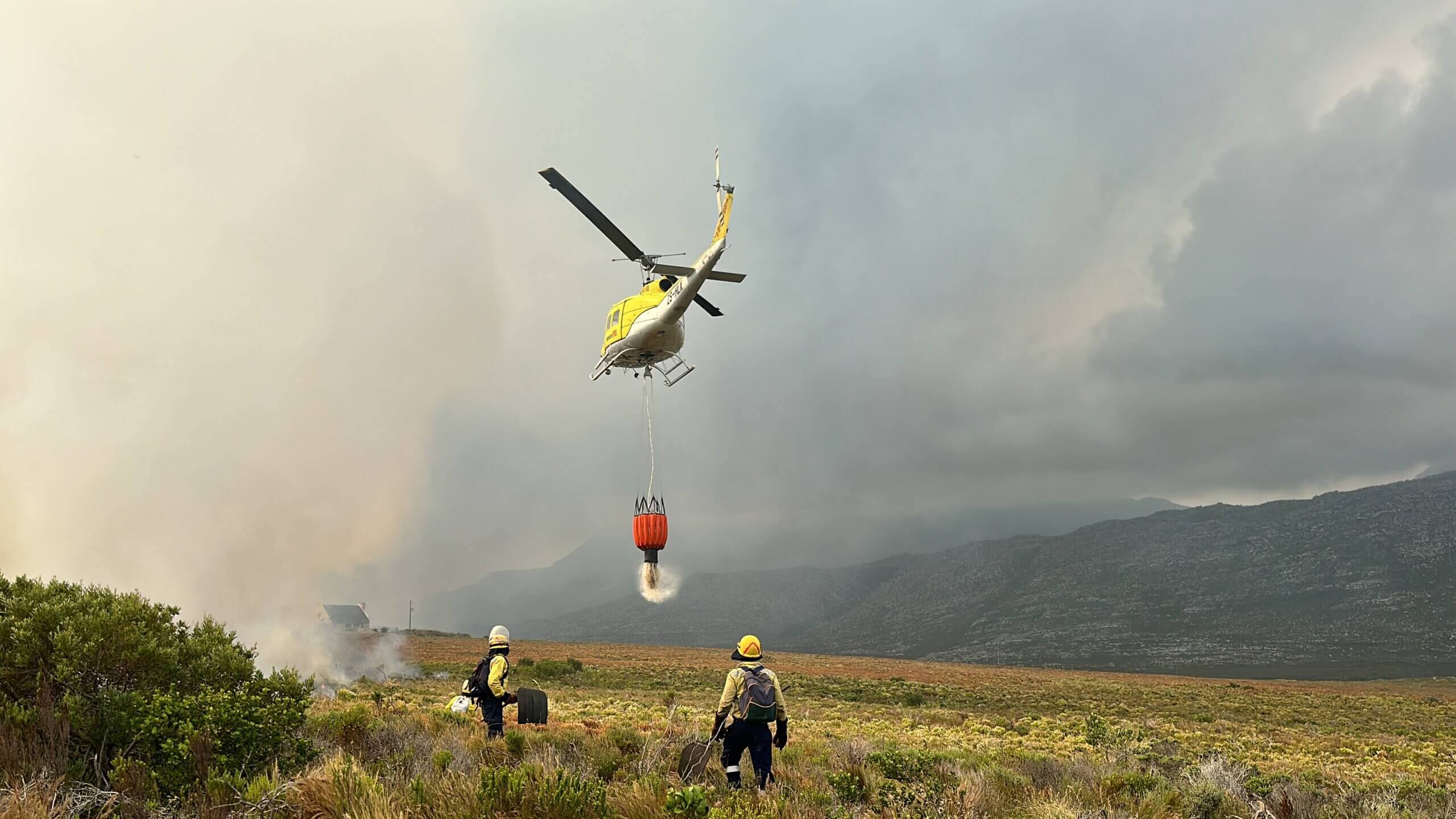
Photo courtesy of Working on Fire.
As in most countries, South Africa’s aerial firefighting resources, (excluding the occasional use of military helicopters) are privately owned and operated. However, the government-funded Working on Fire programme also includes support for aerial firefighting. The expanded public works programme has grown to employ 5300 firefighters and is supported by Kishugu Aviation’s 10 Hueys, four AT802s, 14 Spotter aircraft and a contracted Black Hawk helicopter.
Other than the national government funded Working on Fire programme, provincial governments, municipalities in fire prone regions, conservation agencies, and fire protection associations enter various contractual arrangements to give them access to the country’s aerial firefighting resources. The Western Cape provincial government has an innovative golden-hour grant, through which it pays for the first hour of aerial resources for any wildland fire in the province, thus facilitating rapid deployment of aerial resources and resulting in many fires being contained within the first hour of detection.
The extent of the wildland fire threat in South Africa outstrips current aerial firefighting resources and sometimes the costs associated with such resources inhibits its use at precisely the time when it could make a significant difference. This is particularly the case as wildland fires, under the influence of climate change, are increasingly extending into the ‘food basket’ grasslands and savannah in South Africa.
The growing impact of climate change will necessitate greater international collaboration in aerial fire fighting. Europe has already led developments in this regard, and sharing of pilots and aircraft is also likely to feature in the future of wildland fire management. It is imperative that forums such as the International Fire Aviation Working Group (IFAWG) be resuscitated across the globe to facilitate meeting this challenge.
 Trevor Abrahams is the managing director of the Working on Fire Programme and chairperson of the Kishugu Aviation Division (Pty) Ltd board of directors. He previously established the South African Civil Aviation Authority and served as the Commissioner for Civil Aviation between 1998 and 2003. Abrahams obtained his commercial aircraft and certified flight instructor certificates from the USA Federal Aviation Authority while studying in the United States in the 1980s.