MAINTAINING GOOD MENTAL HEALTH
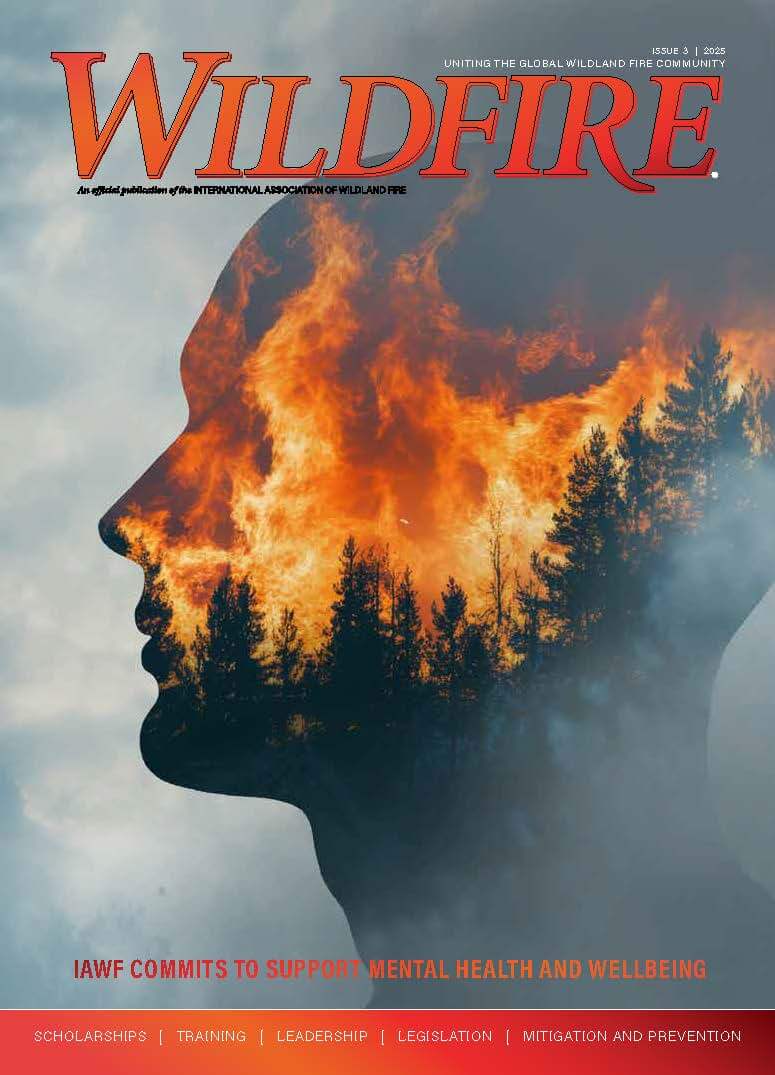
Our cover story, written by longtime IAWF member and associate editor Rich McCrea, explains the association’s commitment to providing insight and tools to help wildland fire personnel work through the challenges of maintaining good mental health.
Maintaining good mental health is challenging for everyone in a digital world loaded with political venom. For wildland fire personnel, from land managers to crew bosses to firefighters, maintaining good mental health is, as the influencers say, next level.
The IAWF position statement Health & Wellbeing in the Wildland Fire Sector was developed by researchers and issued by the association’s board of directors.
Essentially, the paper holds the IAWF accountable to its members and to fire personnel worldwide to promote health and wellbeing for everyone who works in the wildland fire sector.
How will the IAWF do that? As McCrea explains, the IAWF has embraced a series of actions to coordinate efforts by individuals, workplaces and systems, and will promote research, knowledge and experience sharing. There are four long-term actions and five immediate actions to which the IAWF has committed (page 19), including advocacy and partnerships.
Bequi Livingston knows a lot about the challenge of maintaining good mental health. Livingston, a former hotshot, resumed health and wellness column (pages 22-24) a couple of years ago and has provided wisdom, insight, personal stories of love, loss, agony and success.
In this issue, Livingston tackles coping skills, and tells a moving story about fear on deployment caused by an overwhelmed nervous system. Livingston is a resource who has learned how to maintain – or resume – good mental health even in the worst circumstances. Livingston is a wonderfully open and honest writer, mentor and teacher; her contact information is at the end of her column on page 24. Anyone experiencing mental health challenges is welcome to connect with Livingston – a fellow firefighter and manager – for guidance on resources and a path back to good mental health.
We’re fortunate in this issue to have four compelling feature stories.
On pages 12 through 15, Erin Myers and Steve Miller explain the U.S. Department of Agriculture Forest Service’s prescribed burn course for agency administrators.
The workshops help the Forest Service meet its goals to treat an additional two million acres of hazardous fuels on national forests and grasslands annually, and to support partners by treating an additional three million acres of hazardous fuels annually on other federal, state, tribal and private lands.
Starting on page 28, IAWF board member Tiago Oliveira writes about the path for a fire-adapted Europe in an era of massive wildfires, fatalities, and property loss. When G7 leaders met in Canada in June and signed the Kananaskis Wildfire Charter endorsing a whole-of-society approach to wildfire, two key reports had just been released in Europe to develop a framework for governance and prevention.
The European Academies Science Advisory Board report, Oliveira says, “notes the firefighting trap or paradox – the overreliance on fire suppression rather than fuels and land management exacerbates future fires – argues that fire suppression alone is not sufficient, and questions the efficacy of EU policies for their overwhelming focus on fire suppression and emergency response.”
Wildfire associate editor Lindon Pronto helped to develop the remarkable feature story Born of the Flames (pages 32-36), by Khaled Taleb, which describes the founding of Lebanon’s Akkar Trail Firefighting Team.
And on pages 38 through 44, Natasha Caverley and Keith Atkinson explain the workings of the Forest Practices Board in British Columbia, which audits forest practices, investigates complaints, conducts special investigations, issues special reports, and reviews determinations made by government related to the province’s Forest and Range Practices Act and Wildfire Act.
We’d love to hear your thoughts on our stories, and your ideas for future issues.
 Managing editor Laura King is an experienced international journalist who has spent more than 15 years writing and editing fire publications. She is the Canadian director for the National Fire Protection Association (NFPA), works closely with FireSmart™ Canada to help residents build resilience to wildland fire, and has participated in the development of the Canadian wildland fire prevention and mitigation strategy.