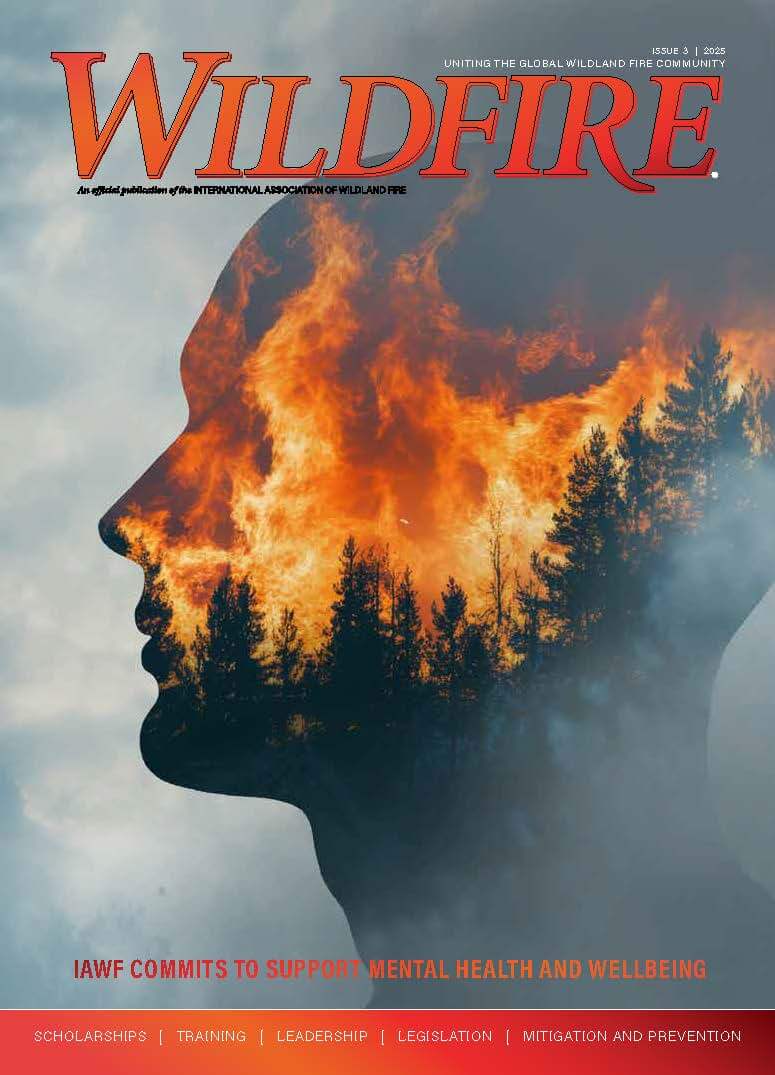
IAWF COMMITS TO SUPPORT MENTAL HEALTH AND WELLBEING: POSITION STATEMENT OUTLINES ACTIONS ASSOCIATION WILL TAKE TO INCREASE KNOWLEDGE AND CARE
BY RICH MCCREA
The International Association of Wildland Fire has committed to promoting health and wellbeing for wildland fire practitioners, their families and support communities.
The IAWF board has approved a position paper titled IAWF Position Statement: Health & Wellbeing in the Wildland Fire Sector, which outlines actions the association will take to ensure everyone involved in the wildland fire sector is aware of mental health challenges and the available support.
The paper outlines the challenges fire practitioners often face, including remote work locations, long assignments, and extended work hours, which contribute to fatigue and high rates of stress, trauma, physical and mental injury.
According to the paper, research indicates that wildland fire practitioners are often repeated victims of direct physical, mental, psychosocial impacts, and injuries. Health and wellbeing can be improved through medical treatments as well as cultural, social, and environmental interventions, the paper says.
The paper defines health and wellbeing in the broadest terms to include cultural, social, social, ecological, physical, mental, and professional wellbeing. In the paper, the term wildland fire practitioners refers broadly to wildland fire managers, firefighters, dispatchers, aviators, land managers, scientists, agency, non-government personnel, volunteers, and contractors.
The paper, which was accepted and endorsed by the IAWF board, was written for the association by members of the diversity and inclusivity committee Phillipa McCormack, DaRon Shavers, and David Riera.
“In publishing this position paper, the IAWF has acknowledged the importance of mental health and wellbeing for the global wildland fire community,” McCormack says.
“Some health and wellbeing considerations for this [wildland fire] community are unique, but many are shared with other emergency and land management sectors, and their families and supporters. We hope that this position paper starts – and helps to maintain – critically important conversations about health and wellbeing across the sector and around the world.”
The IAWF officially launched the paper at the 18th International Wildland Fire Safety Summit and 7th Human Dimensions of Wildland Fire Conference in Calgary, Alberta, in October 2025.
IAWF president Trevor Howard notes that all roles within the wildland fire sector are demanding.
“As climate and fire regimes change, so too will the operational tempo and effects,” Howard said. “While individual, cultural and organizational approaches to wellbeing vary, fundamentally people matter. This paper is a call to action at every level.”
IMPACTS OF WILDLAND FIRE
The paper highlights key research findings about mental health among wildland fire practitioners and recommends actions (see pages 19 and 20) for improving health and wellbeing in the wildland fire sector, joining global efforts for urgent change.
Already, the IAWF advocates for positive health and wellbeing by supporting efforts to influence governments, employers, and policymakers to implement practices that align with increased health and wellbeing among wildland fire practitioners.
The position paper notes that there are many direct and indirect impacts of wildland fire fighting on aspects of health and wellbeing. During fire assignments fire practitioners may be repeatedly exposed to sleep deprivation, job stress, high outdoor temperatures, environmental hazards of rugged terrain, and extreme fire behavior. Impacts on wellbeing can include mental, emotional, cultural and psychosocial stress and injuries from fire, smoke, and heat.
The paper also points to research that indicates employment in wildland fire can limit the availability of alternative job prospects because of the operational tempo of deployments or chronic fire-related injuries. Stress from fire assignments may trigger relationship breakdowns linked to post-traumatic stress and substance abuse. Financial and economic consequences sometimes arise, such as lost work time resulting from injuries, and long-term expenses associated with gradual health impacts.
According to the paper, cultural impacts of working in the wildland fire sector can include systemic harm from culturally unsafe workplaces and environments – conditions that harm First Nations’ and culturally and linguistically diverse peoples’ cultural, spiritual, emotional and physical health. Research cited in the paper shows that wildland fires can have various effects on communities, including evacuations, loss of homes, property, significant sites, aspects of culture, social connections, and livelihoods, which impact health and wellbeing of residents and fire practitioners.
PATHWAYS FOR CHANGE
The paper indicates that health and wellbeing in the wildland fire sector can be improved through coordinated efforts at individual, workplace, and systemic levels, and provides examples of tools in each category.
• Pathways and actions to enhance health and wellbeing start with individual responsibility for health, fitness, readiness, recovery and resilience, action plans, and peer-to-peer mentoring.
• Workplace pathways can include cultural competency and cultural safety training, along with mandatory emotional intelligence programs for team leaders.
• Systemic actions may include researching and identifying pathways for reform to legislation, regulations and policy. People will only be able to use these tools and mechanisms if the financial, emotional and cultural barriers to accessing and using them are removed.
CONTRIBUTING FACTORS
The paper points out that research on wildland fire practitioners’ health is limited, particularly around long term risks such as cancer and cardiovascular disease. Limited research may be due to fire practitioners rarely seeking help, particularly for mental health, despite facing significant physical and psychological stress. According to the paper and previous research, organizational culture and fear of appearing weak contribute to reluctance, leading to issues such as substance abuse, burnout, and disproportionately higher suicide rates among people who work in the wildland fire sector.
The mental-health paper references previous IAWF position papers on climate change and prescribed fire, and notes that climate change is another important factor impacting wildland fire practitioners. Wildfires are becoming larger, more frequent and destructive, in large part due to climate change. Climate change is increasing the length and severity of fire seasons, which will require fire crews to be on call or deployed for longer periods during the fire season. According to the climate-change paper, these long deployments “reduce the time that wildland fire practitioners have to rest, recover and heal from long and intense fire campaigns.” Climate change worsens health risks, with wildfire smoke increasingly aggravating conditions like asthma and lung disease.
CALL TO ACTION
The IAWF Position Statement: Health & Wellbeing in the Wildland Fire Sector is a call to action for organizations that employ wildland fire practitioners to encourage them to take steps to increase health and wellbeing. The paper notes a need for these entities to “commit substantial resources and make a sustained effort to provide health-related education, training and other interventions to contribute enhanced wellbeing, greater resilience, and longterm support for those experiencing injury and trauma.
“Existing efforts have not consistently and successfully mitigated the harm experienced by many people and communities in the wildland fire sector,” the paper says. “As climate changes and wildfire events expand in their scale, scope and duration, these are challenges that the IAWF have identified as critically important and worthy of greater commitment and effort.”
Fire practitioners and agencies often encounter financial, emotional and cultural barriers when working to improve health and wellbeing. Removing these obstacles and ensuring practical access to resources is essential for improving outcomes in the wildland fire sector.
The paper explains the IAWF’s vision, “to seek and promote and contribute to the mental, cultural, physical, and emotional safety of wildland fire practitioners worldwide; and to foster meaningful connections within and across wildland fire practitioner communities, to help build resilience and sustain health and wellbeing.”
The IAWF is committed to promoting opportunities for research, knowledge and experience sharing. To achieve this vision, the IAWF proposes four actions
IAWF ACTIONS
1. Understand the range of stressors affecting wildland fire practitioners, including the compounding and interacting direct and indirect effects of those stressors on health, wellbeing and ‘connectedness.
2. Foster safety, tolerance and diversity in all its forms, along with open communication about health and wellbeing for wildland fire practitioners across countries, cultures and contexts.
3. Promote a culture of active support for wildland fire practitioners to manage these stressors and build and maintain physical, emotional, cultural and other forms of health and wellbeing.
4. Develop and communicate holistic and nuanced messages about health and wellbeing for wildland fire practitioners; including to policymakers, fire agencies, fire practitioners, and non-government organizations associated with wildland fire, including those in support, communication and service provision roles.
In addition, the IAWF has committed to five key actions the association and its members can implement immediately to increase the awareness of health and wellbeing, including building partnerships, advocating for better practices, and creating safe spaces for conversations and mentoring at IAWF events.
Enhancing the health and wellbeing of wildland fire practitioners will contribute to sustaining a resilient and highly qualified workforce and will benefit communities and cultures.
IAWF Commitments
1. Advocate for better understanding and responses to the full range of stressors influencing health and wellbeing;
2. Create and cultivate safe spaces for conversation, empowerment, connection and mentoring at IAWF-supported events and in IAWF programs;
3. Partner with agencies and other organizations to promote the importance of health and wellbeing;
4. Advocate for improvements in policies, practices, workplace cultures and norms that negatively affect health and wellbeing of the wildland fire community, across the world;
5. Investigate new partnerships to facilitate access to new resources, guidance and support for members of the wildland fire sector and their families, communities and environments.
Read the IAWF position paper Health & Wellbeing in the Wildland Fire Sector.
 During his career, Rich McCrea worked 32 years in fire management and forestry with several federal agencies. Outfitted with a degree in forestry, McCrea started his career as a seasonal employee with the US Forest Service as a forestry technician and member of the Helena Interagency Hotshot Crew, then moved on to permanent positions with the US Department of Interior, Bureau of Indian Affairs, as a forester and fire management officer at three different field locations, and at the National Interagency Fire Center. McCrea enjoys hiking, camping, fine books, and writing and research about historical wildfires.