RECOMMENDATIONS FOR CHANGE: THE WAY AHEAD FOR A FIRE-LITERATE AND FIRE-ADAPTED EUROPE
BY TIAGO OLIVEIRA
A new era of wildfire mitigation and prevention in the European Union has been defined by two new wide ranging reports, with the added support of a new global agreement with similar objectives.
• A report by the European Academies Science Advisory Board presented in Brussels on May 19 calls for an integrated European Union framework for landscape fire risk governance and the prioritisation of prevention.
• The European Academies report followed the publication in April of a proposal by Firelogue – a coalition of research projects – for an integrated wildfire risk management strategy.
• And on June 17, G7 leaders and guests meeting in Canada signed the Kananaskis Wildfire Charter, endorsing that nations adopt a whole-of-society approach to wildland fire, focus on prevention, leverage research, and build shared capacity to mitigate and respond.
The European Academies report, Changing Wildfires: Policy Options for a Fire-Literate and Fire-adapted Europe, synthesises state-of-the-art fire science and argues that forest ecosystems and European citizens will be exposed soon to a growing wildfire risk. The report recommends the articulation of policies, actively managing forests, and educating and engaging communities.
Already wildfires in the European Union burn, on average, half a million hectares yearly – almost twice the size of Luxembourg. In 2025, almost 1 million hectares burned.
Worked on by 23 scientists nominated by their respective national science academies, the report highlights the complex drivers behind the surge in wildfire risk.
Amplified by climate change, the drivers tie down to rural depopulation and land use changes. As droughts and declining summer rainfall are predicted to double the fire hazard by 2100, rural abandonment of farmland and unmanaged vegetation growth have created vast landscapes of flammable biomass.
The report notes the firefighting trap or paradox – the over-reliance on fire suppression rather than fuels and land management exacerbates future fires – argues that fire suppression alone is not sufficient, and questions the efficacy of EU policies for their overwhelming focus on fire suppression and emergency response.
Changing Wildfires – Policy Options for a Fire-literate and Fire-adapted Europe
The report presents European political bodies with eight recommendations:
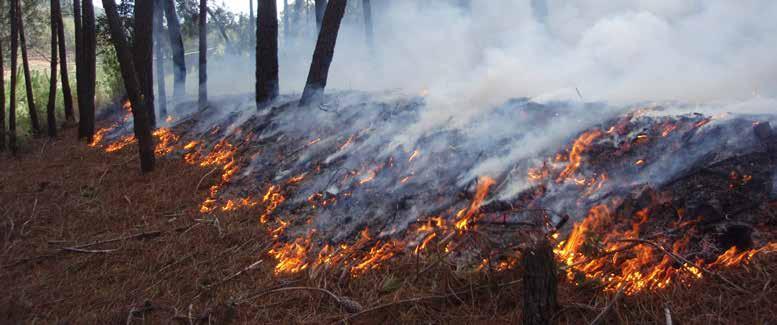
1. Invest in integrated wildfire risk reduction, including prescribed burning and fuel management.
2. Implement nature-based solutions such as grazing and native species reforestation.
3. Embrace the role of fire allowing planned burns to maintain ecological balance.
4. Invest in education and communication to increase “fire literacy” and preparedness.
5. Invest in landscape management to reduce vulnerability, design and maintain resilient landscape that reduces wildfire risks.
6. Harmonise sectoral policies across agriculture, environment, and urban development to reduce conflicts and risks.
7. Promote compact urban development to limit wildland-urban interface expansion.
8. Encourage sustainable private land management to help landowners adopt fire resilient practices.
While the Mediterranean remains Europe’s highest-risk region, the report warns that a continental fire crisis is brewing, and Alpine and Boreal regions must also prepare for a new era of fire.
“The changing regime with larger, more intense blazes is driven not only by weather, but also by structural socio-ecological shifts,” said Orsolya Valkó, co-chair of the European Academies’ Science Advisory Council’s wildfires working group, in a statement in May.
“Many new areas, such as Central Europe and rapidly warming mountainous areas, will probably be exposed to severe fire weather. This marks a fundamental shift with major consequences for environmental and public safety.”
Firelogue – the coalition of research projects – supports wider calls for an integrated European wildfire risk management strategy.
“Following the example of Portugal, we propose that the creation of a strategy should include some key elements such as the creation of an Inter-agency at the EU level, to work transversally with the various agencies and European Commission directorates (DGs) to operationalise the implementation of inter-agency articulation and coordination, to avoid overlaps and gaps,” the Firelogue report says.
“Also, several of the measures proposed in this document concern the activities of some of these agencies including, for example [Directorate-General Environment, Directorate-General Climate, Directorate General European Civil Protection and Humanitarian Aid Operations, Directorate-General for Agriculture and Rural Development, Directorate-General for Structural Reform Support]. In line with this, we also advocate the implementation of a European Wildfire Management Directive as a regulatory framework to guide wildfire risk management activities.”
The Kananaskis Wildfire Charter means that G7 nations –Canada, France, Germany, Italy, Japan, the United Kingdom and the United States – in addition to guest participants Australia, Mexico, India, the Republic of Korea, and South Africa, will move to integrated fire management and high hopes expressed by the G7 for the United Nations Global Fire Management Hub initiative, which is expected to play a pivotal role in fire-era diplomacy.
For the European Union in particular, the way forward is about interoperability, incident command system-based qualifications, common procedures and operational standards, and also the use of knowledge and science to better determine expansion of fire use as a tool in sustainable forest management, nature-based solutions, and Indigenous land management practices including cultural fire risk reduction measures around communities, buildings, and Infrastructure”
To be fire-literate and fire-adapted in Europe, as recommended in the May 19 report, challenges institutions and politicians. The 2023 Landscape Fire Governance Framework, which brings together governments, businesses, academia, and members of civil society to develop and implement balanced and technically supported solutions to landscape fire management, might be helpful for European institutions and decision makers to improve cooperation among civil protection and forest and conservation agendas and organizations, assuring that the pursued objectives are tackled and best practices are adopted.
VIEW THE UNITED NATIONS GLOBAL FIRE MANAGEMENT HUB INITIATIVE
Tiago Oliveira is a PhD and forest engineer with 30 years of experience in national and international activities specialized in the topics of wildland fire risk management and governance. Oliveria was appointed by the prime minister in the aftermath of the 2017 wildfire season to lead the creation of the Integrated Rural Fire Management System in Portugal. He has been chairman of the board of the Portuguese Agency for Integrated Rural Fire Management since January 2019 and is the former head of the Department of Innovation and Forestry Development (2016-2017) at The Navigator Company. Oliveria was head of forest protection, responsible for fire prevention and suppression operational programs and R&D projects, from 2008 to 2016. Oliveria is has been a member of the IAWF board since 2023.